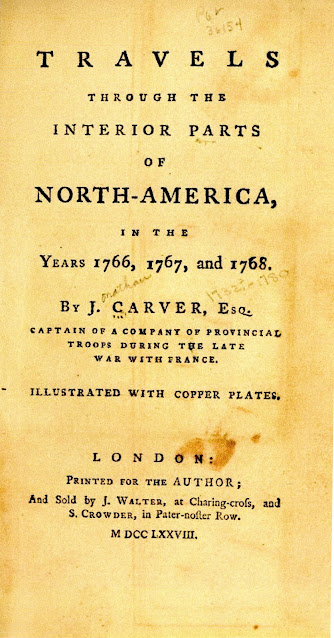
Carver, J. 1778. Travels through the Interior Parts of North
America, in the Years 1766, 1767, and 1768. To which is added, Some Account of
the Author, and a copious Index. First Edition. J. Walter, London. 543 pp.
 |
|
Title
page of Carver’s Travels, First edition. 1778.
|
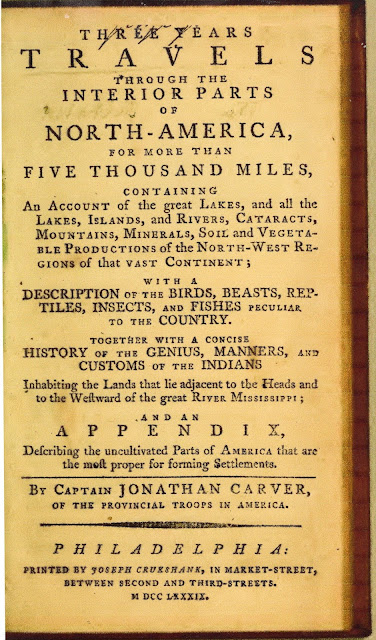
Carver, J. 1779. Three years travels through the interior
parts of North-America, for more than five thousand miles: containing an
account of the Great Lakes, and all the lakes, islands, and rivers, cataracts,
mountains, minerals, soil, and vegetable productions of the north-west regions
of that vast continent : with a description of the birds, beasts, reptiles,
insects, and fishes peculiar to the country, together with a concise history of
the genius, manners, and customs of the Indians inhabiting the lands that lie
adjacent to the heads and to the westward of the great river Mississippi, and
an appendix, describing the uncultivated parts of America that are the most
proper for forming settlements. Second Edition. J. Crukshank, Philadelphia,
Pennsylvania. 282 pp.
 |
|
Title
page of Carver’s Travels, Second edition. 1779.
|
Jonathan
Carver (1710–1780) was one of the first Europeans to extensively explore
regions of the Upper Midwest (Wisconsin, Minnesota, Iowa) and write about his
observations and discoveries. Ostensibly undertaken to discover a Northwest
Passage through the continent, he traveled through the northern Mississippi
Valley from 1766 to 1768 until his funds and supplies were exhausted. When he
returned to New England from his years-long travels, he found that he was not
acknowledged or rewarded for his discoveries, so he went to England in 1769 to
seek recompense from the British Crown. Abandoning his wife and children in
America, he never returned. While In England, he published his Travels, an
account of his adventures and observations on Native communities, which was
extremely popular and well-received. However, he never recovered from his debts,
and eventually died in poverty after remarrying, but without divorcing his
first wife.
Jonathan
Carver was a native of New England, a selectman in Montague, Massachusetts, and
a veteran of the French and Indian War, eventually becoming a captain of
militia. Under the auspices of Robert Rogers and James Tute, he joined an
expedition in 1763 to look for the elusive Northwest Passage. His expedition
left Boston in 1766, traveling to Fort Michilimackinac (now Mackinaw City,
Michigan), then throughout the Upper Midwest through the winter of 1767–1768.
During his travels, he kept extensive journals, which eventually became his
famous Travels. Carver’s book was published in numerous languages, and
there are apparently >40 editions currently available (the book is still in
print). Titles, page numbers, and formats vary somewhat, but the text is the
same. There is considerable debate as to whether Carver wrote everything in his
Travels or had editorial assistance, and of the extent to which he
“borrowed” observations (examined in detail by Kloss, 2018). His legacy further
was marred by subsequent attempts by his heirs to lay fraudulent claim to
substantial tracts of western land. Today, however, Carver is recognized as one
of the most important early explorers of the western frontier, one whose
travels generated strong interest in the New World and its indigenous peoples.
Parker (1976) provides much more information on Carver, his journals, and
subsequent controversies.
Herpetology
in Carver’s Travels is presented on pages 478–490 in the first edition
and on pages 247–255 in the second edition. The wording in both editions is
identical. Most of the accounts refer to snakes (Of Serpents): the Rattle
Snake, the Wall or House Adder, the Long Black Snake, the Striped or Garter
Snake, The Water Snake, the Hissing Snake, the Green Snake, the Thorn-Tail
Snake, the Speckled Snake, the Ring Snake, and the Two-Headed Snake. No where
in the text, except for the accounts of the Rattle Snake and snakes on islands
in western Lake Erie, does Carver imply he actually saw these snakes. No
locality data are given except for those on the aforementioned islands, which
are not mentioned by precise name.
As might be
expected, the longest account refers to the rattlesnake, of which he states
there are two kinds, a black species and a yellow species. They are said to be
exactly the same except for color, and are now recognized as different color
phases of the Timber Rattlesnake (Crotalus horridus). Carver provides a
reasonably accurate description of this species and, unlike contemporaries,
deems them “very beautiful,” with colors “extremely pleasing.” He repeats some
errors of his time (e.g., that the number of rattles reflects the snake’s age;
that venom varies in potency seasonally (e.g., Lawson, 1714); that rattlesnakes
are charmed by music), but refutes others (e.g., that rattlesnakes are overly
aggressive; that all bites are fatal; note that other authors had mentioned similar
observations). He gives a description of the fang, fang sheath, and venom
gland, and describes how a rattlesnake bites and the immediate symptoms of a
bite. He noted that rattlesnakes do not lay eggs, but he thought the young
sought the protection of the mother’s mouth as a place of security. Native Peoples
used a variety of herbs (Rattlesnake Plantain, bark from the White Ash) to
treat the bites. Europeans mixed rattlesnake galls with chalk for medicinal
purposes and exported the concoction to Europe, and the flesh could be dried or
made into a broth. In the narrative on the customs of Native Americans, Carver
noted that in the Naudowessie (Dakota) language, rattlesnakes were called Omlishcaw
(p. 256 in the first edition, p. 130 in the second edition). Carver also
provides details of a “tall tale” told to him concerning a rattlesnake faithfully
returning to its owner (pp. 43–45 in the first edition, pp. 22–23 in the second
edition).
 |
|
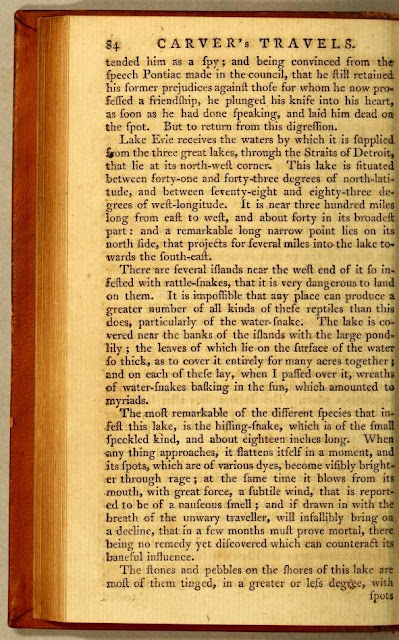
Carver’s
observations on snakes on islands in the western part of Lake Erie. Second
edition, page 84.
|
In Carver’s
account, rattlesnakes were considered so numerous on islands in western Lake
Erie that it was considered dangerous to land (p. 167–168 in first edition, p.
84 in second edition; Fig. 3). As Langlois (1964) later recounted: “the Jesuit
explorer, Bonnecampe, visited the region on October 5, 1749, [and] that he
referred to them as "Les lies aux Serpentes" (The islands of snakes).
A French soldier (J.C.B.), enroute from Presqu'ile, near the eastern end of
Lake Erie, to Detroit, spent the night of July 21, 1754, on one of these
islands, and recorded in his journal (1941) that his party killed 130
rattlesnakes before they dared to sleep.” Carver’s account is reprinted
verbatim in the 1806 edition of Brooke’s General Gazetteer, First American
Edition.
After the
rattlesnake account, there is no further mention or description of the Wall or
House Adder, so it is impossible to determine to which snake Carver refers. All
further accounts are very short, and some of the species are easily identified
to genus, although not necessarily to species: Striped or Garter Snake (Thamnophis
sp.), the Water Snake (Nerodia sp.), the Green Snake (Opheodrys
vernalis), and the Ring Snake (Diadophis punctatus). The description
of the Long Black Snake seems to be a composite of several species, but
definitely the Blue Racer (Coluber constrictor) in part. The
Speckled Snake, likewise, seems to describe a composite of several species.
Carver states that it is an “aqueous reptile,” so perhaps it refers to Pantherophis
gloydi, a species found around marshes and on offshore islands in western
Lake Erie. Carver describes the Thorn-Tail Snake as similar to those found
elsewhere in North America, possessing a thorn-like dart on the end of its
tail, with which “it is said to inflict a mortal wound.” No such species occurs
in the area traveled by Carver, but similar traits have been attributed to Mud Snakes
(Farancia abacura) in the southern United States. Water Snakes (now Lake Erie Watersnakes, Nerodia
sipedon insularum) were considered extremely numerous on islands in western
Lake Erie (Fig. 3), and Carver noted behavior in the Hissing Snake that suggests
he was reporting on Eastern Hognose Snakes (Heterodon platirhinos),
although this species currently is rare in the islands (Langlois, 1964). Many
of the myths associated with this species are repeated in the Hissing Snake
paragraph (Fig. 3).
The most
significant herpetological report in Carver’s Travels is the notation of
a two-headed snake from the Lake Champlain region. However, this snake had been
previously mentioned by Bancroft (1769), complete with an illustration (Fig.
4). The snake was found in 1762 by Lieut. Moses Park and gifted to Lord Amherst1.
There was no description of the snake in Carver’s account. The Reverend
Manasseh Cutler was shown an illustration of this snake on a visit to Benjamin
Franklin in 1787. A comparison of the Lake Champlain snake with a dicephalic
snake found near Philadelphia suggested that Franklin’s Philadelphia snake was
an Eastern Kingsnake (Lampropeltis getula), and was similar to the illustration
of the Lake Champlain snake2. This and the accompanying illustration
in Bancroft suggest the latter was an Eastern Milksnake (L. triangulum)
(Wallach, 2007). It is likely that the illustration shown to Reverend Cutler by
Dr. Franklin came from Bancroft’s book. Thus, Carver’s notation of the snake
was not original, but the popularity of his book likely stimulated interest in
such oddities from the New World.
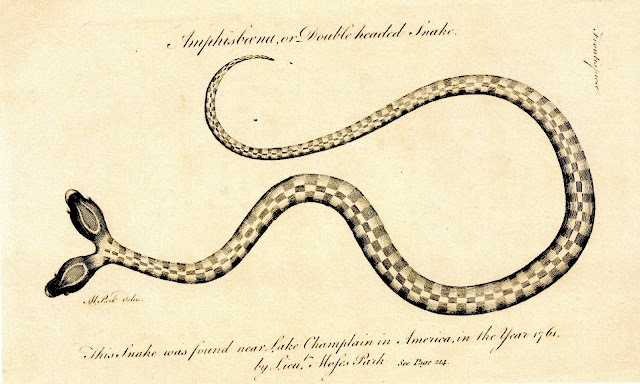 |
|
Two-headed
snake from Lake Champlain. From Bancroft (1769). Illustration by Lieut. Moses
Park.
|
The final
herpetology notes are short. They cover the Tortoise or Land Turtle, clearly a
reference to
Terrapene carolina, although it is said to be venomous, and
Lizards &. Lizards are divided into the Swift Lizard, a reference to
Plestiodon
fasciatus with its dark dorsum, bright stripes, and bright blue tail, and
the Slow Lizard. Swift Lizards were said to be poisonous, but not dangerous,
preferring to run away quickly. Slow Lizards, also likely
P. fasciatus,
were said to be identical with Fast Lizards except that they were brown
dorsally. Slow Lizards readily broke off their tails (i.e., tail autotomy). The
herpetology section ends with a paragraph on Tree Toads (Gray Treefrog complex,
Dryophytes versicolor/ chrysoscelis), a frog with “claws” (toepads) that
resembled tree bark, and “infest the woods in such numbers, that their
responsive notes at these times [morning and evening] make the air resound.”
Although an
early account of the herpetology of the Great Lakes Region and, possibly,
westward, are Carver’s observations of significant interest to modern researchers?
Perhaps not. There is little doubt that Carver traveled extensively during his Travels,
but considerable controversy exists among historians as to the originality of
his observations and writings. According to Bourne (1906), “Scholars are in
general agreement that much of the work in this volume is an abridgement or
adaptation of historical writings of Charlevoix, Adair, and La Hontan. Entire
chapters read as near verbatim text from one or more of these other authors.” Bourne
(1906) amply documents extensive plagiarism in Carver’s Travels,
although this practice was not uncommon at that time. For example, among Carver’s
natural history accounts, much information on mammals is derived from Pierre
Françoise
Xavier de Charlevoix’s (1682–1761) Histoire et Description Generale de la
Nouvelle France (1744), although that is not the case for his
herpetological observations. I can find no outright instances of herpetological
plagiarism, but descriptions in the Rattle Snake account (fang like a cat’s
claw, green venom) are similar to the those from Kalm (1758), perhaps suggesting
that Carver and his collaborators (see Kloss, 2018) were familiar with earlier accounts
of rattlesnakes. The inclusion of the Lake Champlain two-headed snake, published
originally by Bancroft (1769), tends to support the assumption that at least
some of Carver’s observations were “borrowed” from other sources.
Carver’s personal
journal suggests important differences between his text and the published book,
although many of the incidents described in the book appear to be true based on
discoveries of his journals and letters (Kloss, 2018). Likewise, previous
suggestions that Carver was barely literate seem inaccurate. Unfortunately, his
herpetological accounts contain poorly described snakes, no locality data, and
a substantial admixture of folklore that would have been commonly circulated at
the time. As noted above, the most important contribution of Carver’s Travels
to herpetology was the first widely disseminated report of a dicephalic snake
in North America, and he did not find that!
Acknowledgments. – I thank Van Wallach for information on
Carver’s dicephalic snake.
Notes
1. Jeffrey Amherst, 1st Baron Amherst (1717–1797), was a
British Army officer and Commander-in-Chief of the Forces in the British Army.
He advocated genocide against Native Americans, putting smallpox in blankets to
distribute to First Nations peoples. Because of this, he is held in contempt by
many Canadians and Americans today.
2. Benjamin Franklin’s interest in snakes extended beyond
natural history, i.e., as an emblem for American independence. See Cook (1996).
References
Bancroft, E. 1769. An essay on the natural history of
Guiana, in South America. T. Becket and P.
A. De Hondt, London. 402 pp. [Lake Champlain snake account on p. 215; the
illustration is a frontispiece to
the book]
Bourne, E.G. 1906. The Travels of Jonathan Carver. American
Historical Review 11(2):287-302.
Charlevoix, P. 1744. Histoire et
Description Generale de la Nouvelle France, avec le Journal Historique d’un Voyage fait par ordre du Roi dans l’Amérique
Septentrionnale. Tome Premier. Chez Rolin Fils,
Paris. 543 pp. [Available at: https://www.biodiversitylibrary.org/item/254745#page/1/mode/1up]
Cook, K.S. 1996. Benjamin Franklin and the snake that would
not die. British Library Journal 22:88–111.
Cutler, W. P., and J. P. Cutler. 1888. Life, journals and
correspondence of Rev. Manasseh Cutler, LL.D. by his grandchildren. Vol. 1. Robert Clarke & Co., Cincinnati,
Ohio. 524 pp. [Franklin’s two-headed snake
account on pp. 268–269] [Available at: https://archive.org/details/lifejournalscorr01cutl/page/n5/mode/2up?ref=ol&view=theater]
Kalm, P. 1758. An account of the Rattle-snake, and the cure
of its bite, as used in North America. In A. von Haller (ed.), Medical, Chirurgical, and Anatomical Cases and
Experiments, pp. 282–293. A. Linde,
P. Davey and B. Law, and J. Staples, London.
293 pp.
Kloss, J. 2018. Jonathan Carver's "Travels Through The
Interior Parts of North-America" (1778) - What's Available Online?
https://hummingadifferenttune.blogspot.com/2018/03/Carver.html. (Accessed 13 October 2022)
Langlois, T.H. 1964. Amphibians and reptiles of the Erie
islands. Ohio Journal of Science 64:11–25.
Lawson, J. 1714. New Voyage to Carolina; Containing the
Exact Description and Natural History of That Country:
Together with the Present State Thereof. And a Journal of a Thousand Miles,
Travel'd Thro' Several Nations of
Indians. Giving a Particular Account of Their Customs, Manners, &c., London. [Reprinted 1936, Garrett and Massie
Publishers, Richmond, Virginia, 259 pp]
Parker, J. 1976. The Journals of Jonathan Carver and Related
Documents, 1766-1770. Minnesota Historical
Society, Minneapolis. 244 pp.
Wallach, V. 2007. Axial bifurcation and duplication in
snakes. Part I. A synopsis of authentic and anecdotal
cases. Bulletin of the Maryland Herpetological Society 43:57–95.
For Further
Information on Jonathan Carver’s Travels:
The Project Gutenberg eBook of Travels through the Interior
Parts of North America, in the Years 1766, 1767 and 1768, by Jonathan Carver.
Produced by Sonya Schermann and the Online Distributed Proofreading Team. Release
Date: August 21, 2015 [eBook #49753]. Available at
https://www.gutenberg.org/files/49753/49753-h/49753-h.htm#Page_479.
Gould, Heidi. Carver, Jonathan (1710-1780). MNopedia.
https://www.mnopedia.org/person/carver-jonathan-1710-1780 (Accessed 11 October
2022)
Gregory, J.G. 1896. Jonathan Carver. His travels in the
Northwest in 1766–8. Parkman Club Publishers (Milwaukee, Wisconsin) No.
5:73–101. [Available through the Hathi Trust; https://babel.hathitrust.org/cgi/pt?id=aeu.ark:/13960/t3902rf22&view=1up&seq=6]
Submitted by: C. Kenneth Dodd, Jr.