|
Ananjeva, N. B. and I. V. Doronin 2021. Herpetological century: 100th Anniversary of the Division of Herpetology, the Zoological Institute of the Russian Academy of Sciences, St. Petersburg. Bibliotheca Herpetologica 15(12):118–127. Published October 29, 2021. In 2019 the herpetological community of Russia celebrated 100 years since establishment of the Department of Herpetology of the Zoological Museum (known as the Zoological Institute since 1931). This paper contains information about the scientists who led the department during this period, the herpetological collections housed by the Institute, the scientific fields of study and main projects of the staff, and the geographic areas in which they worked. |
 |

Friday, October 29, 2021
Bibliotheca Herpetologica 15(12)

Friday, October 15, 2021
Biblitheca Herpetologica 15(11)
|
Dodd, C. K. 2021. Book Review. The Last Turtlemen of the Caribbean. Waterscapes of Labor, Conservation, and Boundary Making. Bibliotheca Herpetologica 15(11):113-117. Published October 15, 2021. Perhaps from the time of first human settlement along the coasts and islands of the Caribbean, the Green Turtle (Chelonia mydas) has been a source of sustenance. Its eggs were obtained easily along the sandy shorelines, and its meat has been much sought after by coastal peoples worldwide. As an added advantage, the shell and bones could be used as utensils and carved as tools. Although not as tasty as Greens, Hawksbill Turtles (Eretmochelys imbricata), too, oviposited protein-rich eggs on the remote islands, and their beautiful shell has been desired by craftsmen through the ages in all parts of the world. When European imperial fleets, pirates, traders, and slavers entered the Caribbean, they found an “inexhaustible” supply of food in Green Turtles for their long voyages and to feed crews, workers, and slaves on land. Hawksbill scutes offered a further lucrative trade item. But the turtle populations were not inexhaustible, and nesting areas of former abundance, particularly in Bermuda, the Cayman Islands, and the Dry Tortugas, were decimated. |
 |
Biblitheca Herpetologica 15(10)
|
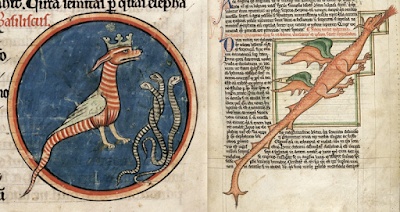
Savage, J. M. and B. I. Crother 2021. The snakes of Dante’s Inferno and Lucanus’ de Bello Civili (Pharsalia). Bibliotheca Herpetologica 15(10):106–112. Published October 15, 2021. “In the middle of the journey of our life I found myself within a dark woods where the straight way was lost.” Thus begins the famous poem, La Divina Commedia, by Dante Alighieri (1265–1321 AD). That poem is generally considered to be the greatest literary work of the Middle Ages and ranks among the greatest in Western literature (Durant 1959: 1980). It consists of three parts in thirty-four Cantos (Longfellow 1867abc). It describes Dante’s passage through Inferno (Hell), Purgatorio (guided by the shade of the Roman poet Virgil), and through Paradiso (Heaven) by Beatrice, Dante’s ideal woman. |
 |
Subscribe to:
Posts (Atom)